


Orchard & Vineyard Slope Maintenance with RC Mowers
Introduction: Challenging Ground in Permanent Crops
Orchards and vineyards are among the most demanding environments for vegetation management. Steep inter-row slopes, tight clearance between tree rows or vine posts, uneven terrain created by irrigation berms, and the absolute requirement to avoid crop damage all conspire to make conventional ride-on mowing impractical and potentially dangerous. Remote-control (RC) slope mowers have emerged as the equipment of choice for progressive orchard and vineyard operators worldwide.
This article examines the operational requirements, machine selection considerations, and best-practice workflows that enable RC mowers to deliver consistent, high-quality sward management across permanent crop plantings on sloped land.
Why Conventional Mowing Fails in Orchards and Vineyards
Inter-row widths as narrow as 1.8 m restrict conventional tractor-mounted equipment
Side-hill slopes of 15–40° exceed the stable operating envelope of standard ride-on mowers
Root zone compaction from repeated heavy machinery passages reduces vine and tree vigour
Operator fatigue on continuous slopes with vibration and dust exposure increases error risk
Turning at row ends on steep cross-slopes presents overturn hazards for conventional mowers
Key Fact: Studies in Steep Slope Viticulture (2023) found that operator injury rates for conventional mowing in vineyards with slopes above 25° were 3.8× higher than for flat-site operations.
RC Mower Characteristics Suited to Permanent Crops
Compact Footprint & Narrow Track Width
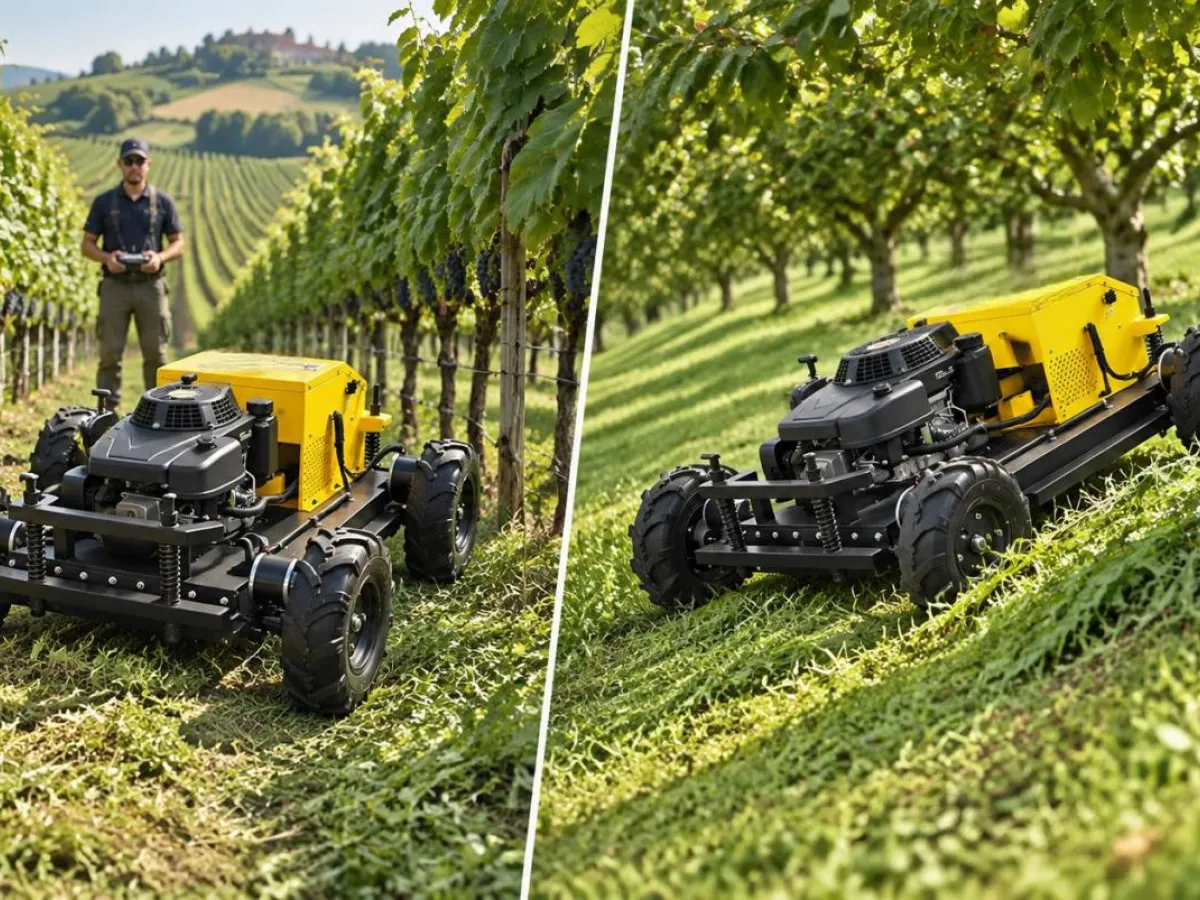
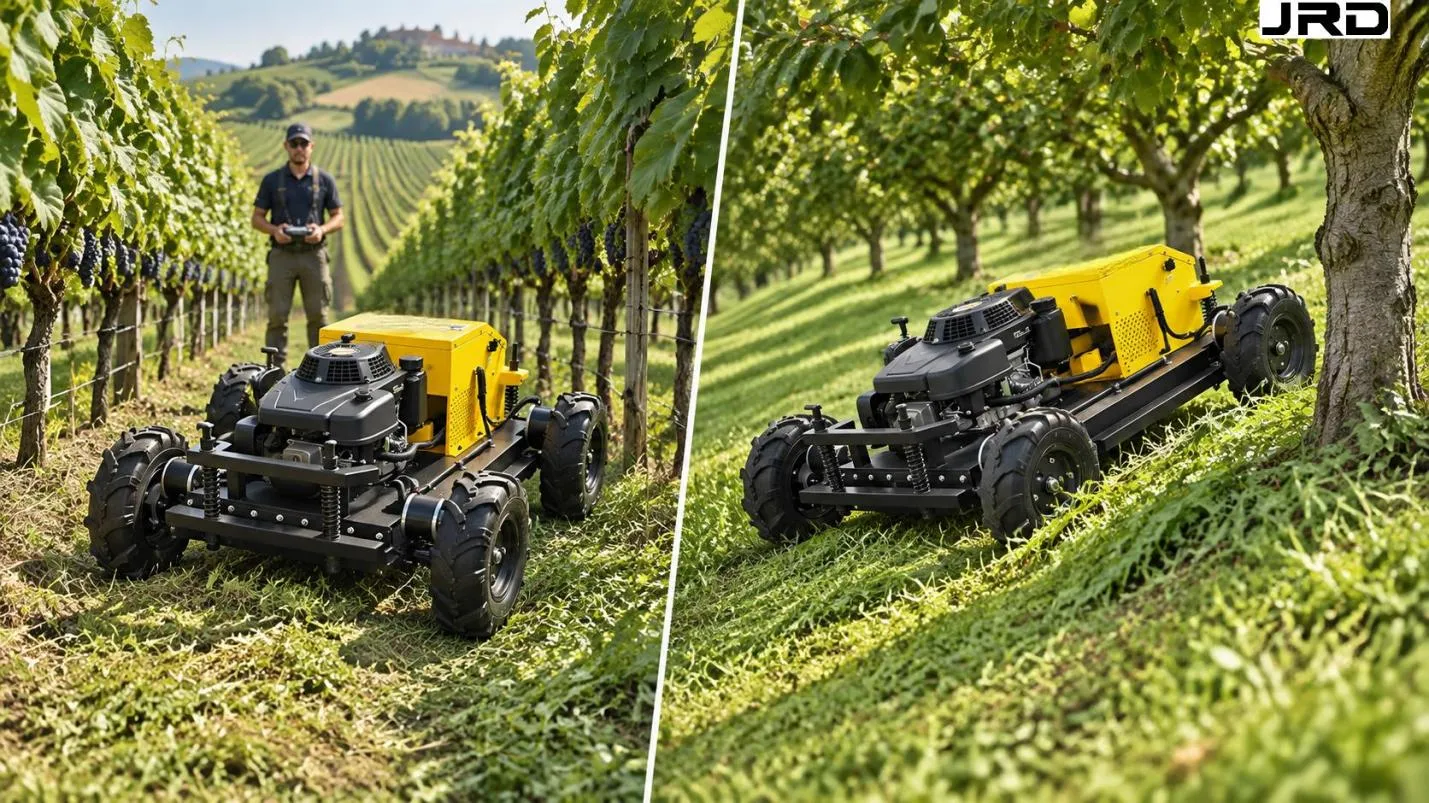
Leading RC slope mowers offer track widths from 850 mm to 1,200 mm, allowing passage between established vine rows or orchard trees without post or trunk contact. Rubber track systems distribute ground pressure below 0.05 bar, protecting shallow feeder roots.
Slope Capability
Dual-tracked RC platforms operate reliably on gradients up to 55°, covering the full range of commercially planted permanent-crop slopes including steep terraced vineyards in Mosel, Douro, and Priorat appellations.
Low Ground Disturbance
The absence of an operator cab eliminates the heaviest single point load on slope mowers. Combined with track systems, soil disturbance is minimised, preserving erosion-control cover crops between vine rows — a critical sustainability requirement in premium viticulture.
Cutting Deck Options
Flail mulcher decks (450–1,200 mm width): standard for inter-row grass mulching, returns biomass to soil
Disc mower heads: fast cutting for high-biomass green manure crops between rows
Reciprocating bar cutters: suited to delicate under-vine areas near trunk bases
Brush-cutting drums: handles bramble and blackthorn invasion in neglected orchards
Operational Workflow: Vineyard Inter-Row Mowing
Pre-Season
Inspect rows for fallen posts, irrigation pipe, netting
Remove hazards before mowing programme starts
First Cut
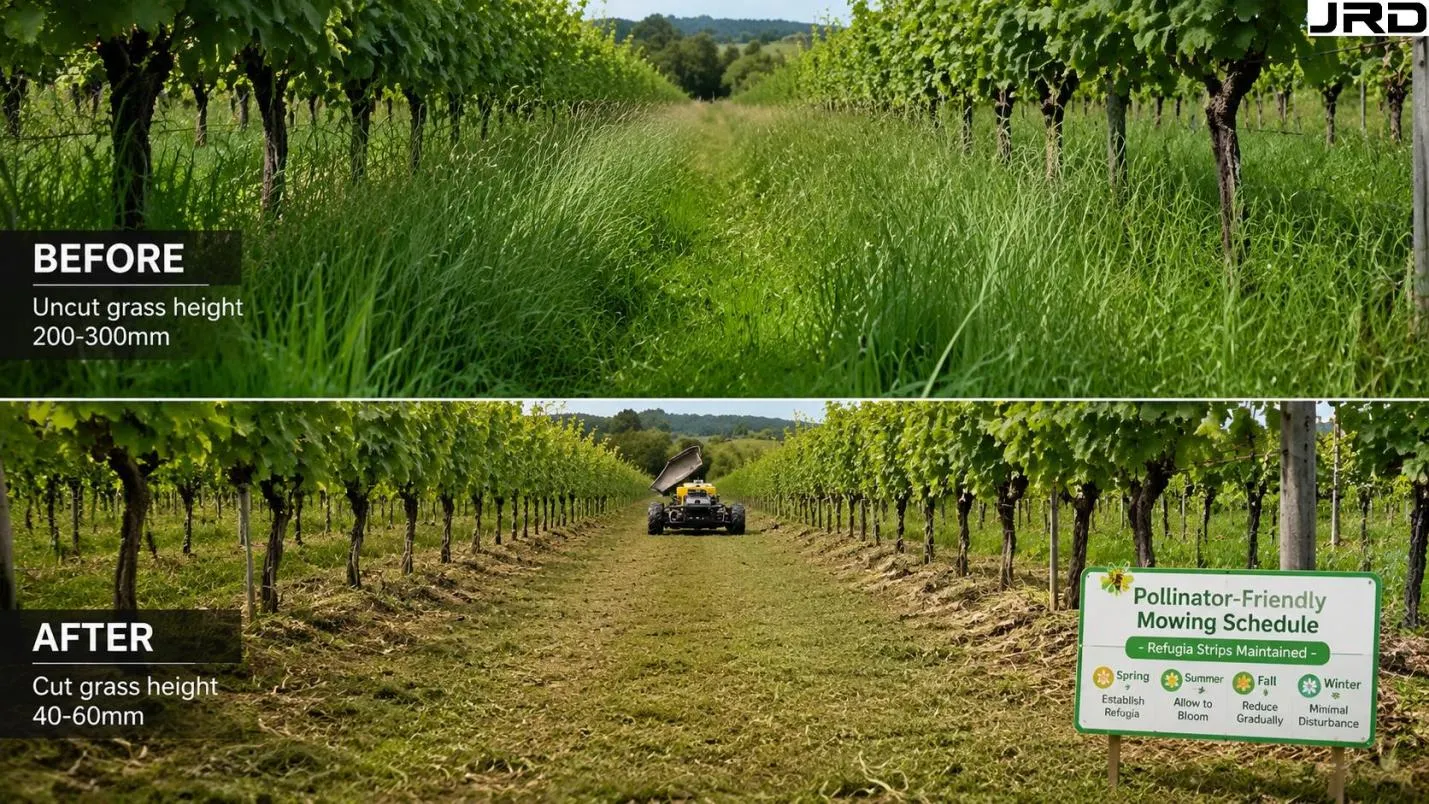
High cut at 80–100 mm: establish baseline sward height
Avoids scalping uneven inter-row crowns
Routine Cuts
40–60 mm cut every 3–4 weeks during growing season
Match grass growth rate to avoid excessive biomass
Under-Vine Strip
Hand-guide RC unit on short passes parallel to row
Maintain 150 mm clearance to trunk base
Harvest Preparation
Final cut to 30 mm: provides clean headland for picking bins and harvest machinery
Complete 10 days before harvest begins
Post-Harvest
Allow inter-row sward to recover; no mowing after leaf fall
Prevents nitrogen loss before winter dormancy
Operators should work along the slope (contour mowing) rather than up and down wherever possible. This approach keeps the RC mower's centre of gravity stable on the lateral axis and reduces the risk of downhill slide on wet turf.
Orchard Applications: Specific Considerations
Fruit Drop Management
During fruit set and ripening periods, fallen fruit on the inter-row floor creates a significant slip and mulching hazard. RC flail mowers can be fitted with front-mounted fruit deflectors that push fallen apples or pears clear of the cutting path, preventing blade damage and juice contamination of the sward.
Berm and Bank Navigation
Tree-row berms created by herbicide sprayer wheel ruts or irrigation mounding can reach 200–300 mm above the inter-row floor. Articulating cutting decks with floating head technology automatically follow ground contours, maintaining consistent cutting height across berms without operator adjustment.
Seasonal Biological Constraints
Avoid mowing during pollinators' peak activity (mid-morning to mid-afternoon on open flowering cover crops)
Schedule cuts to protect nesting skylark and partridge pairs — typically avoid March–June in European orchards
Maintain uncut refugia strips in alternate rows to provide invertebrate habitat corridors
Economic Case: RC vs Tractor-Mounted Mowing
Capital Cost
£35,000–£60,000
£55,000–£95,000
Fuel per Hour
5–8 L diesel
1.5–2.5 L diesel
Operator Risk
High (slope instability)
Low (remote operation)
Row Width Minimum
2.5 m
1.0 m
Max Slope Capability
~20°
Up to 55°
Ground Compaction
High
Very Low
While initial capital outlay is higher for RC platforms, total cost of ownership over five years typically favours RC mowers in vineyards and orchards with significant slopes or narrow inter-row widths, due to fuel savings, reduced machinery damage from slope incidents, and elimination of high-risk manual mowing tasks.
Summary & Recommendations
RC slope mowers represent a purpose-designed solution for the challenging demands of orchard and vineyard vegetation management. Their ability to operate on steep gradients, navigate narrow inter-row gaps, and minimise root zone compaction addresses the key shortcomings of conventional mowing equipment in permanent-crop settings.
Select a track width compatible with your narrowest inter-row spacing plus 300 mm clearance
Specify a floating cutting head to handle inter-row berms and crown undulations
Implement a contour-mowing approach on all slopes above 15°
Plan mowing schedules around pollinator and nesting bird constraints
Record cut dates, heights, and fuel consumption in a vegetation management log to support agroenvironmental scheme compliance
Specifying an RC mower for orchard or vineyard work? JRD Machinery is an RC slope mower manufacturer and supplier of narrow-track machines with flail, disc, and reciprocating deck options, and we can match track width to your narrowest inter-row spacing. We also advise on contour mowing technique and cutting schedules that satisfy agroenvironmental scheme requirements. Contact us with your row dimensions and slope range.
Email:info@JRDmachinery.com
Website: www.JRDmachinery.com