



Mini Excavator for Demolition Work — Breaker, Ripper, and the Right Machine Weight
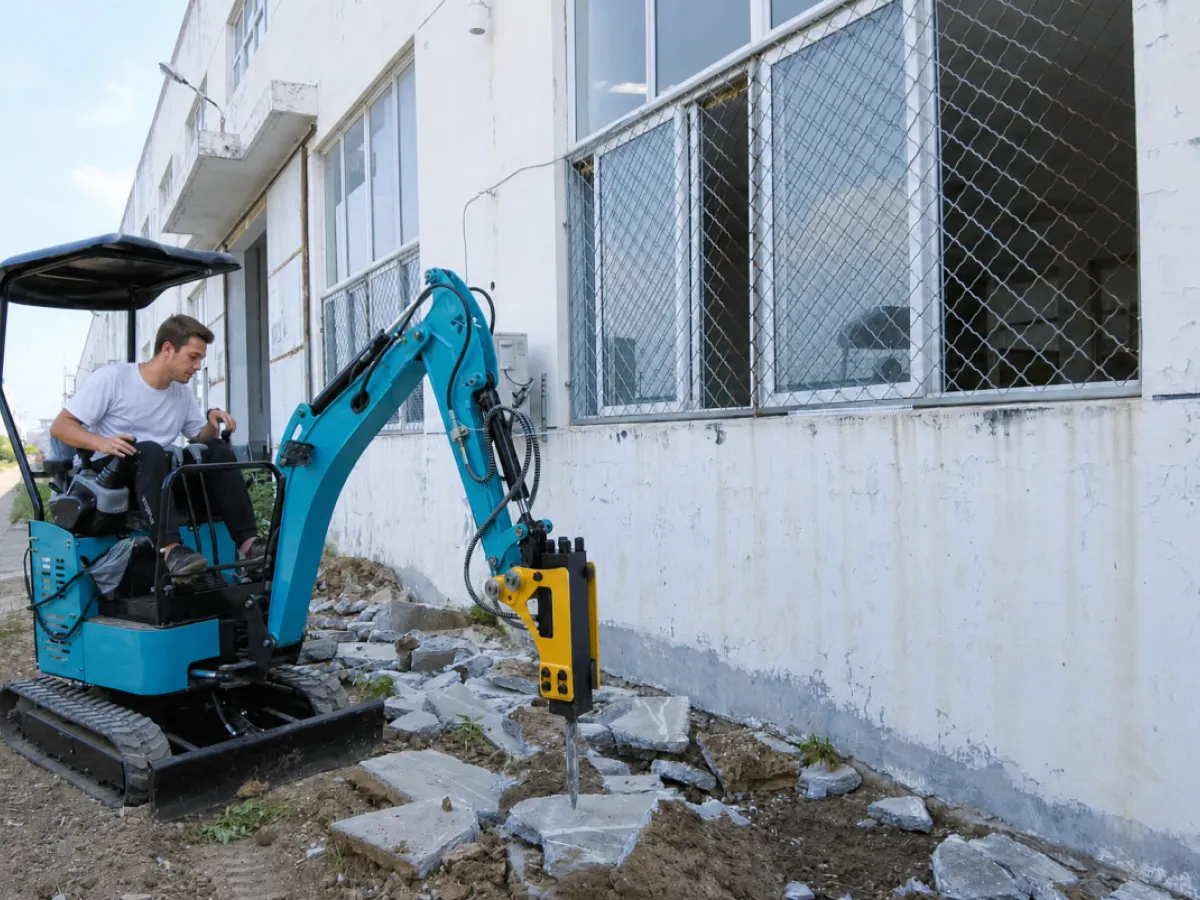
Demolition work puts compact excavators under the highest stress in their operating envelope: sustained hydraulic load from the breaker circuit, vibration transmitted through the arm and boom to every structural joint, and operating conditions where the machine may be surrounded by falling material. Mini excavator demolition applications — breaking reinforced concrete slabs, removing old foundations, selective interior demolition, clearing masonry within confined sites — require a machine specified correctly for this load profile, not simply the smallest machine that can access the site.
The common mistake in specifying compact excavators for demolition is optimising for access geometry alone. A machine that fits through the door is useful only if it can also break the material inside the door efficiently and safely. This article addresses the machine weight threshold below which hydraulic breaker performance degrades, the difference between breaker and ripper for different demolition materials, the cab protection requirement for overhead-hazard environments, and the operating technique that extends machine life when breaking is a primary daily task.
Machine Weight and Breaker Performance — The Physics Behind the Minimum
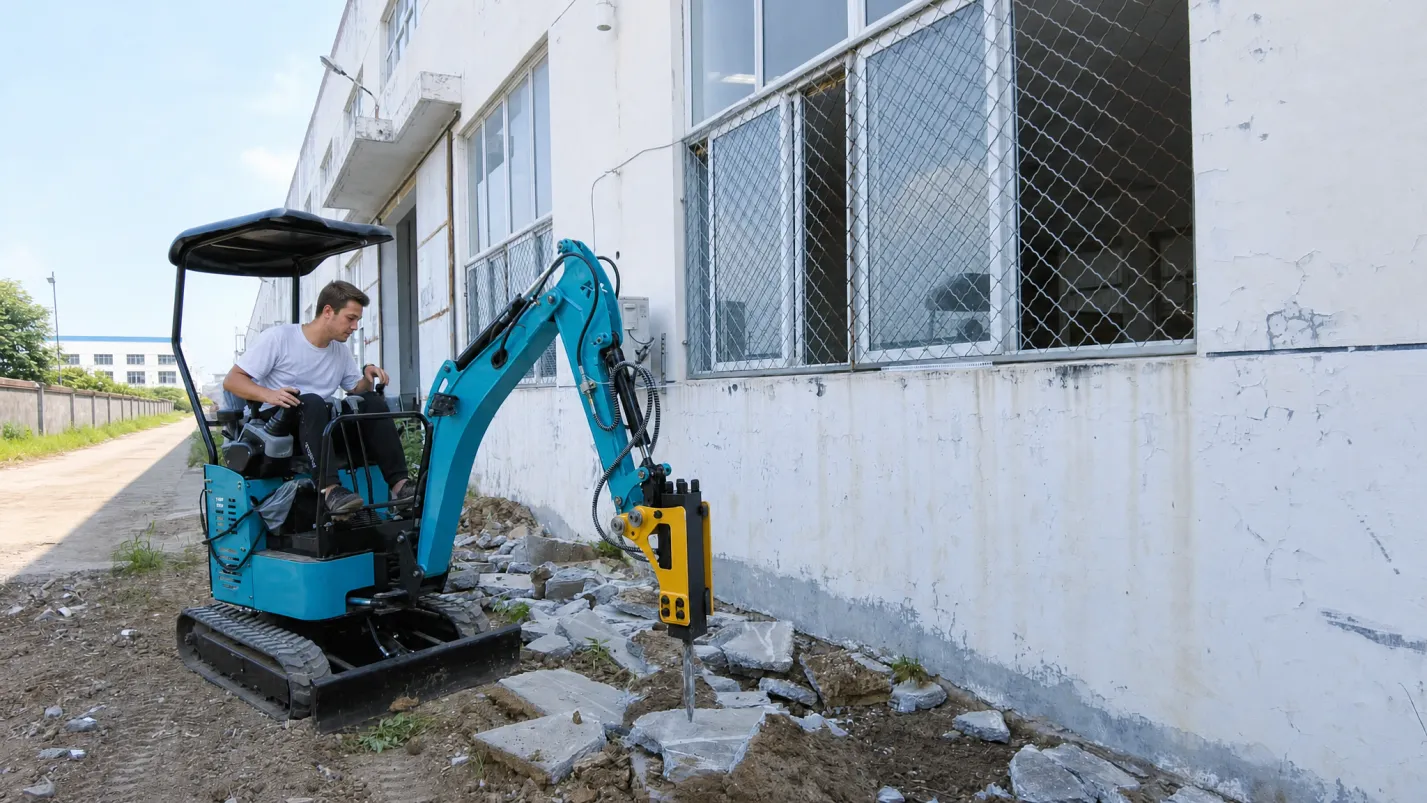
A hydraulic breaker works by delivering repeated high-energy blows to a tool steel chisel pressed against the material being broken. Each blow generates a reaction force that pushes the breaker body back against the machine arm. If the machine is heavy enough, the reaction force is absorbed by the machine's mass and the chisel remains in contact with the material through the entire blow cycle. If the machine is too light, the reaction force bounces the machine up and back with each blow — the chisel skips rather than penetrates, energy is wasted, and the breaking rate drops dramatically.
The practical weight threshold for mini excavator demolition with a hydraulic breaker depends on the material being broken and the breaker model weight. For breaking standard 150 mm unreinforced concrete or old brick masonry, a machine in the 1,000 to 1,200 kg class with an appropriately sized small breaker can produce acceptable results. For reinforced concrete of 200 mm or greater thickness, the machine weight needs to be in the 1,500 kg and above category to provide enough hold-down mass. The 17 series at 1,700 kg and 13.5 kN digging force is the model in this range where breaker performance on medium concrete becomes consistent and productive rather than marginal.
The 20 series at 1,850 kg and the 22 series at 2,100 kg with 15 kN digging force handle larger breakers for heavier demolition applications. At this weight class, the machine can run a breaker rated for serious reinforced slab breaking while maintaining the compact site footprint that differentiates a 2-tonne machine from a 5-tonne excavator.
Hydraulic Breaker Flow Matching — The Same Rule as the Auger, Applied to Demolition
As with auger drill attachments (covered in Article 56), hydraulic breaker performance is governed by the flow and pressure that the machine's auxiliary circuit delivers versus what the breaker's hydraulic motor requires. A breaker that receives too little flow cycles slowly and doesn't develop full blow energy; a breaker that receives too much flow bypasses the excess through its internal relief valve as heat without increasing output.
The Taifeng multi-way valve fitted to the 17 series allows auxiliary flow adjustment without tools, which means the circuit can be calibrated to the specific breaker being used — a significant advantage when the machine runs different breaker sizes on different jobs. On machines with fixed auxiliary flow (the Q-series models), the breaker selection must be made to match the machine's set output rather than the other way around.
One specific technical point about breaker operation that is often missed: breakers should not be operated at maximum engine throttle when the tool is not in contact with the material. Running the breaker in air — the tool swinging without surface contact — sends full-pressure cycles through the breaker body without the load that the valving is designed to manage, accelerating internal component wear. The correct technique is to press the tool firmly against the material before activating the breaker circuit, maintain contact through the breaking sequence, and deactivate the circuit before lifting the tool from the surface.
Ripper vs Breaker — Choosing the Right Tool for the Material
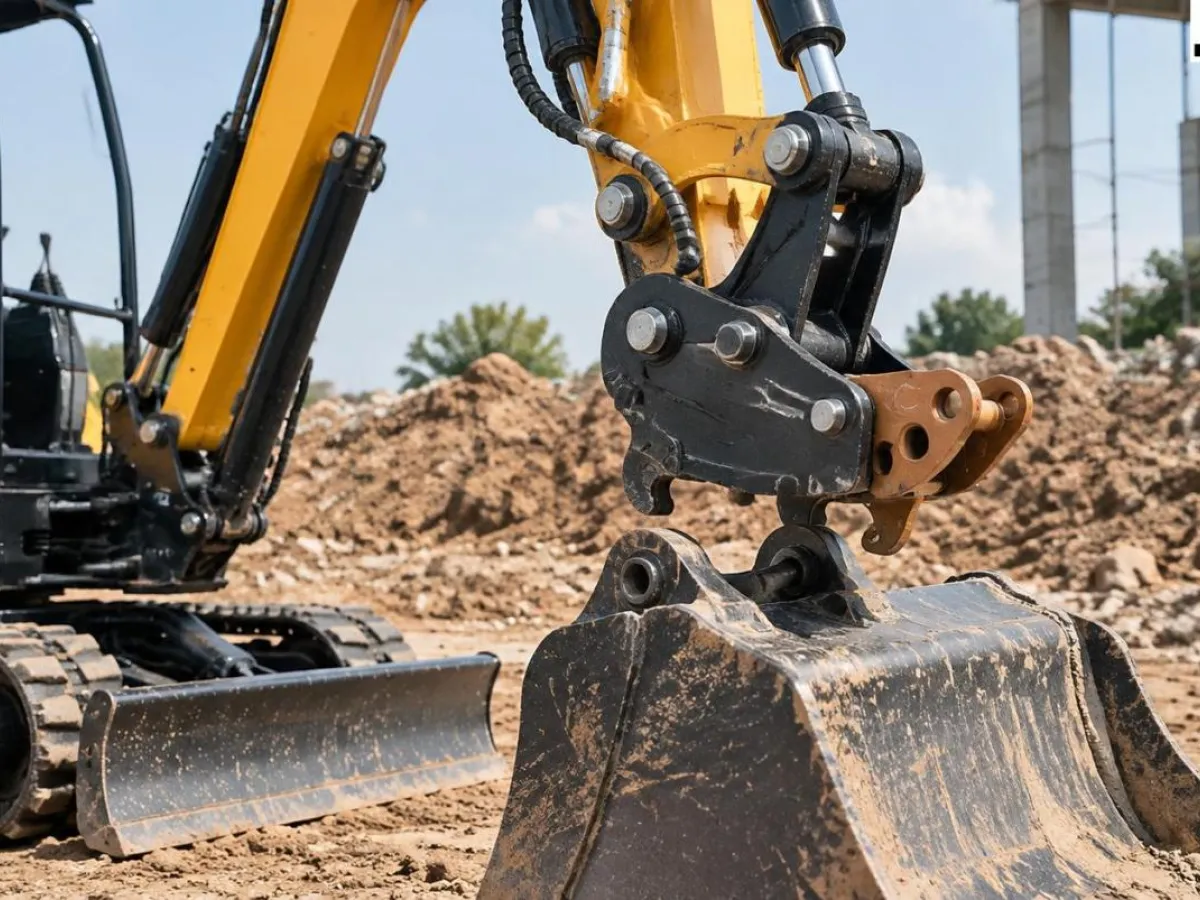
The single-tooth ripper — a heavy steel tooth mounted in the bucket attachment position — is often overlooked in mini excavator demolition planning because it lacks the visual drama of a hydraulic breaker. But for lightly reinforced concrete, aged masonry, compacted fill, and old asphalt, the ripper is frequently the faster and cheaper tool.
The ripper works by applying the machine's full digging force through a single concentrated point. At 13.5 kN in the 17 series, the ripper tip exerts enormous point pressure against the material surface — enough to crack and lift old concrete paths, break up basement slab sections that aren't heavily reinforced, and rip through root systems that would bounce a digging bucket. Because it uses the machine's standard hydraulic circuit rather than the auxiliary circuit, it does not introduce the thermal load that breaker work does, and the machine can run the ripper continuously without the overheating risk that sustained breaker operation creates.
The ripper's limitation is material hardness and reinforcing density. In concrete with heavy rebar — structural slabs and foundations — the ripper lifts the concrete panels but cannot cut the steel, leaving the operator to manage sections still tied together by reinforcement. In this situation, the breaker is the correct primary tool because it can sever the concrete matrix around individual rebar sections rather than trying to lift them intact. In mixed demolition where some areas are heavily reinforced and others are not, having both tools available on a quick coupler-equipped machine allows the operator to switch between them as the material condition changes.
Cab Specification for Demolition Environments
Interior demolition in existing structures creates overhead hazard from falling ceiling material, disrupted wiring, lightweight partition debris, and occasionally larger structural elements. An open canopy ROPS structure provides rollover protection but not FOPS falling-object protection. For any demolition application where the machine is working under existing structure — partial building demolition, basement slab removal, interior strip-out — the full enclosed cab with FOPS certification is the correct and in most regulated markets the legally required specification.
The practical point that ties cab specification to mini excavator demolition site access: the enclosed cab adds height to the machine profile. In low-ceiling demolition environments — basement rooms with 2.2-metre ceiling height, for example — the full cab height may prevent the machine from working upright under the ceiling. The solution in this case is to confirm the machine's operating height in the cab-fitted configuration before committing the machine to that site. The 17 series in closed cab configuration has an operating height that must be checked against the specific site ceiling before deployment.
In exterior demolition where the machine is working below existing overhanging structure but is not within an enclosed space, the FOPS guard attached to an open canopy frame is sometimes available as a stand-alone option. This provides FOPS overhead protection without the full enclosed cab height penalty. Confirm availability of this configuration at the point of order — it is not universally available across all models.
Operating Practices That Extend Machine Life During Demolition Work
Demolition is the most mechanically demanding application in the compact excavator's operating envelope, and the machines in this range are designed to handle it — but operating practices significantly affect how long the machine handles it without accelerating component wear beyond the design service intervals.
The most important practice is the one noted above: breaker contact maintained throughout the break cycle. The second most important is boom position during breaking — keeping the boom angle such that the arm is working at roughly 45 to 60 degrees from vertical when the breaker is engaged. At this angle, the arm cylinder is near its most efficient mechanical position and the hydraulic force is transmitted most efficiently to the breaker tool. At extreme arm extension or extreme arm retraction, the mechanical advantage is reduced and the hydraulic circuit has to work harder for the same output.
Slewing the machine while the breaker is running is a common error that causes accelerated wear at the slewing ring and at the boom foot pin. The breaker should be deactivated before slewing to reposition, and reactivated after the machine is stationary in the new position. In continuous production breaking work, the extra two seconds per cycle adds up to perhaps 10% additional cycle time — but the reduction in slewing ring wear typically extends the component life by 30 to 40% compared to machines that slew under breaker load routinely.
Finally, greasing the breaker mounting pins and the boom and stick foot pins at the interval specified for breaker work — typically half the standard greasing interval — is the maintenance task most directly linked to long machine life in demolition applications. The vibration from breaking cycles displaces grease from bearing surfaces faster than standard digging work, and the consequences of inadequate lubrication at these wear points are expensive to correct once wear has progressed.
Specifying compact excavators for demolition, concrete breaking, or interior strip-out work?
JRD Machinery offers CE-certified mini excavators from 1,000 kg to 2,100 kg with ROPS/FOPS cab options, auxiliary hydraulic circuits for breaker and ripper attachments, and quick coupler systems for multi-attachment demolition workflows.
Visit www.JRDmachinery.com for demolition-specific model recommendations, or contact our technical team with your site access dimensions and demolition material specification for a matched equipment proposal.